- Home Assistant Connect ZBT-2
- Pre-Requisites
- Docker Compose
- Add Home Assistant Integrations
- Add Matter Devices via Home Assistant App
- Extra Credit
- Troubleshooting
- Factory Reset
- References
Home Assistant Connect ZBT-2
Instead of using a hub like the IKEA DIRIGERA to communicate with Matter/Thread home-automation devices, I went with the open-source route and purchased a Home Assistant Connect ZBT-2.
Firmware Installation
- Plug the ZBT-2 into your laptop.
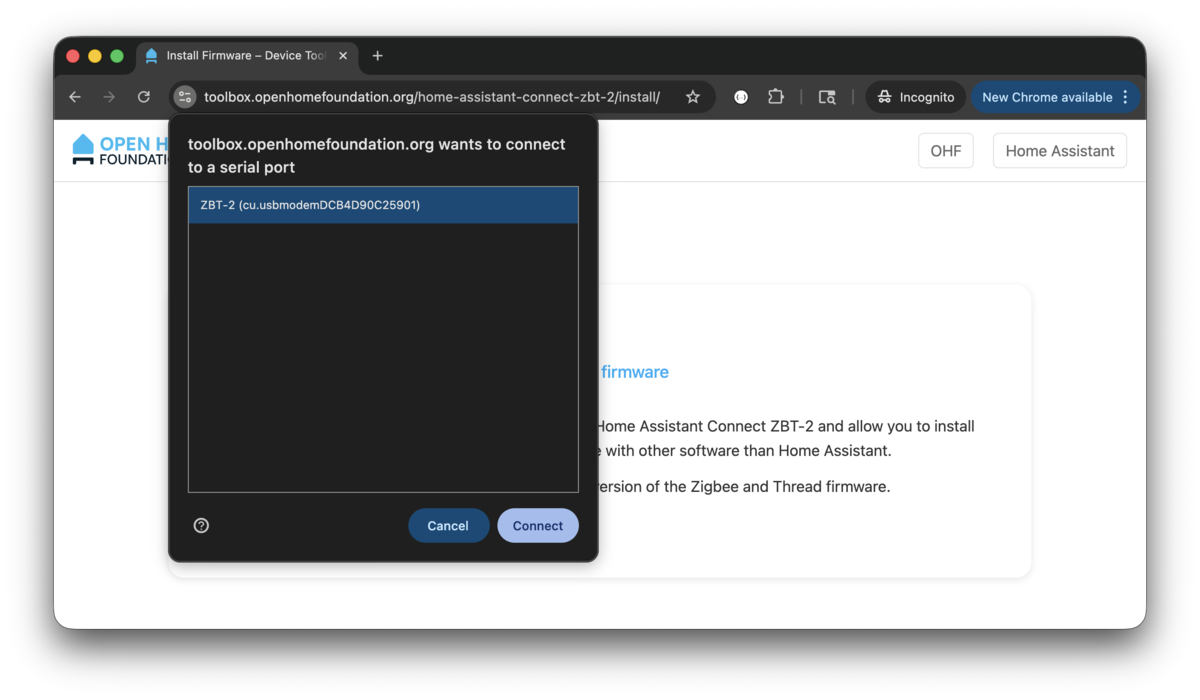
- Go to toolbox.openhomefoundation.org with Chrome.
- Click
INSTALL FIRMWARE. - Select the ZBT-2 device and click
Connect. - Click
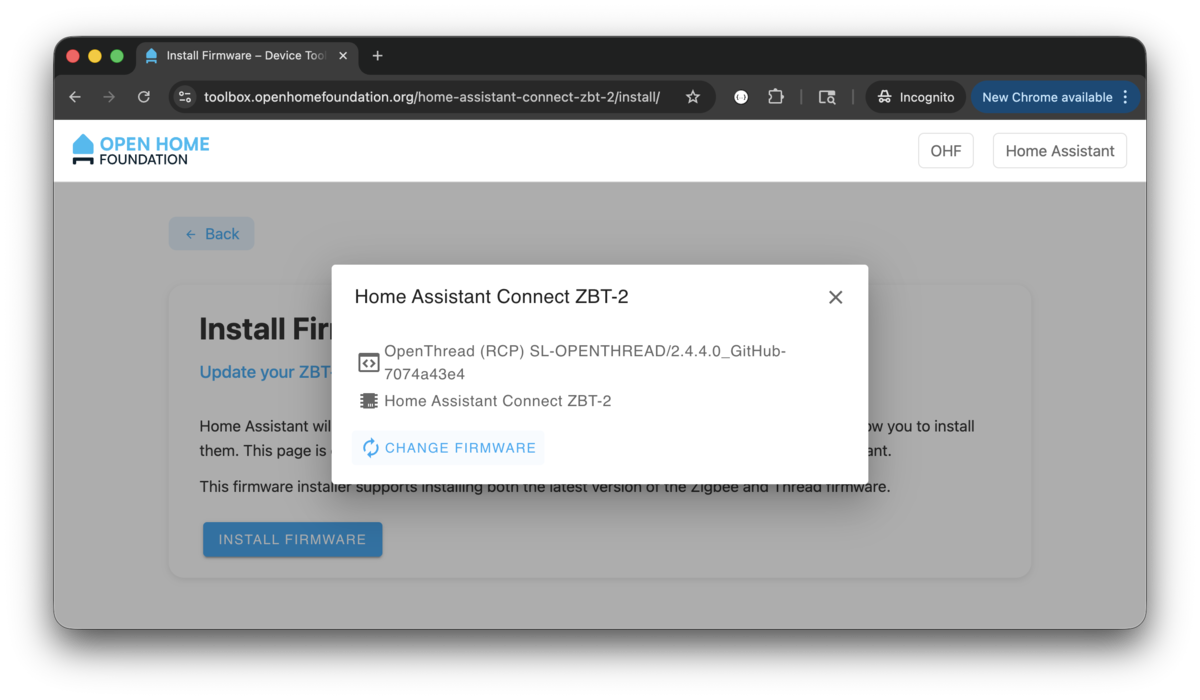
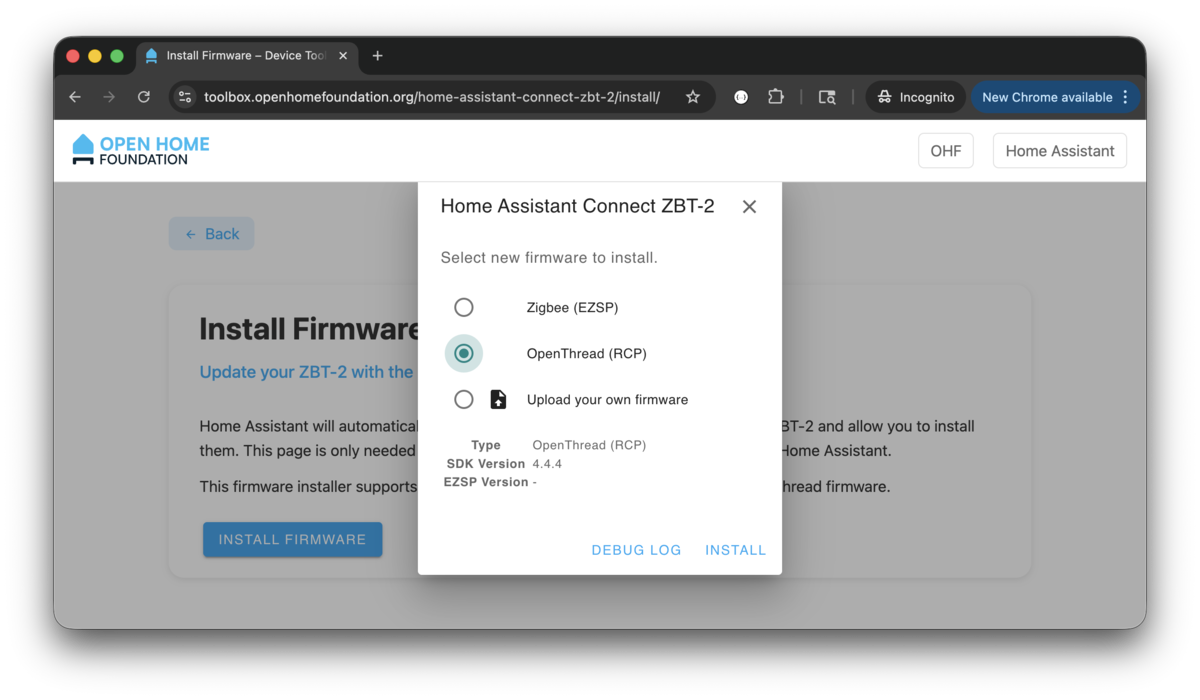
CHANGE FIRMWARE, selectOpenThread (RCP)firmware, and clickINSTALL.
Connect to Raspberry Pi
Plug the ZBT-2 into the Raspberry Pi and confirm it shows up. Use the /dev/serial/by-id/ path in the docker-compose config.
$ ls -lh /dev/serial/by-id/*
lrwxrwxrwx 1 root root 13 Jan  1 16:35 /dev/serial/by-id/usb-Nabu_Casa_ZBT-2_DCB4D90C2590-if00 -> ../../ttyACM0
Pre-Requisites
IPv6 Sysctl Settings
OTBR requires IPv6 forwarding and router advertisement settings to route Thread traffic to the LAN. Without these, accessory pairing will fail silently — devices join the Thread network but cannot reach the Matter server.
Replace br0 with your interface name (typically eth0 if you don’t have a bridge).
sudo sysctl -w net.ipv6.conf.all.forwarding=1
sudo sysctl -w net.ipv6.conf.all.disable_ipv6=0
sudo sysctl -w net.ipv6.conf.all.accept_ra=2
sudo sysctl -w net.ipv6.conf.all.accept_ra_rt_info_max_plen=64
sudo sysctl -w net.ipv6.conf.br0.forwarding=1
sudo sysctl -w net.ipv6.conf.br0.accept_ra=2
sudo sysctl -w net.ipv6.conf.br0.accept_ra_rt_info_max_plen=64
To persist across reboots, create /etc/sysctl.d/90-thread-matter.conf:
net.ipv6.conf.all.forwarding=1
net.ipv6.conf.all.disable_ipv6=0
net.ipv6.conf.all.accept_ra=2
net.ipv6.conf.all.accept_ra_rt_info_max_plen=64
net.ipv6.conf.br0.forwarding=1
net.ipv6.conf.br0.accept_ra=2
net.ipv6.conf.br0.accept_ra_rt_info_max_plen=64
Then reload:
$ sudo sysctl --system
Avahi Daemon
Ensure /etc/avahi/avahi-daemon.conf has at least the following options. This restricts mDNS to br0 (the bridged network interface) and prevents Docker virtual interfaces from leaking advertisements.
[server]
use-ipv4=yes
use-ipv6=yes
allow-interfaces=br0
deny-interfaces=docker0,veth*,br-*
ratelimit-interval-usec=1000000
ratelimit-burst=1000

[wide-area]
enable-wide-area=yes

[publish]
publish-addresses=yes
publish-hinfo=no
publish-workstation=no
publish-domain=yes
$ sudo systemctl enable avahi-daemon
$ sudo systemctl restart avahi-daemon
$ sudo systemctl status avahi-daemon
Router Advertisement Daemon
radvd is an IPv6 router advertisement service. Advertisements let devices on the local network:
- Learn the IPv6 prefix to use
- Autoconfigure their own IPv6 addresses (SLAAC)
- Discover the default router
- Learn specific routes
Replace the interface name and prefix with yours.
fd15:9ef4:1f7f:9c18::/64: ULA prefix (IPv6 equivalent of private address space like 192.168.x.x)
Notice! If radvd is stopped, accessory pairing will fail.
interface br0
{
    AdvSendAdvert on;
    MinRtrAdvInterval 3;
    MaxRtrAdvInterval 10;

    prefix fd15:9ef4:1f7f:9c18::/64
    {
        AdvOnLink on;
        AdvAutonomous on;
        AdvRouterAddr on;
    };

    route fd15:9ef4:1f7f:9c18::/64
    {
    };
};
$ sudo systemctl enable radvd
$ sudo systemctl restart radvd
$ sudo systemctl status radvd
Docker Compose
Notice! OT_INFRA_IF is set to br0 because I have a bridge configured on my Pi. Yours is likely eth0.
services:
  home-assistant:
    container_name: home-assistant
    image: ghcr.io/home-assistant/home-assistant:stable
    environment:
      TZ: America/Los_Angeles
    network_mode: host
    privileged: true
    restart: unless-stopped
    volumes:
      - './home-assistant/config:/config'
      - '/etc/localtime:/etc/localtime:ro'

  matter-server:
    container_name: matter-server
    image: ghcr.io/matter-js/python-matter-server:stable
    network_mode: host
    privileged: true
    restart: unless-stopped
    security_opt:
      - apparmor:unconfined
    volumes:
      - './matter-server/data:/data'
      - '/run/dbus:/run/dbus'

  otbr:
    container_name: otbr
    image: openthread/border-router:latest
    cap_add:
      - NET_ADMIN
    devices:
      - /dev/serial/by-id/usb-Nabu_Casa_ZBT-2_9C139EAC8D34-if00:/dev/ttyACM0
      - /dev/net/tun:/dev/net/tun
    environment:
      OT_RCP_DEVICE: spinel+hdlc+uart:///dev/ttyACM0?uart-baudrate=460800
      OT_INFRA_IF: br0
      OT_THREAD_IF: wpan0
      OT_LOG_LEVEL: 7
      OT_REST_LISTEN_ADDR: 0.0.0.0
      OT_REST_LISTEN_PORT: 8081
      OT_WEB_LISTEN_ADDR: 0.0.0.0
      OT_WEB_LISTEN_PORT: 8981
    network_mode: host
    privileged: true
    restart: unless-stopped
    volumes:
      - './otbr/data:/data'
Start the services:
$ docker compose up home-assistant otbr matter-server --remove-orphans -d
[+] Running 3/3
 ✔ Container otbr            Running
 ✔ Container matter-server   Running
 ✔ Container home-assistant  Running
Confirm container status:
$ docker compose ps --format "table{{.Name}}\t{{.Image}}\t{{.Service}}\t{{.RunningFor}}\t{{.State}}\t{{.Status}}"
NAME             IMAGE                                           SERVICE          CREATED          STATE     STATUS
home-assistant   ghcr.io/home-assistant/home-assistant:stable    home-assistant   49 seconds ago   running   Up 48 seconds
matter-server    ghcr.io/matter-js/python-matter-server:stable   matter-server    49 seconds ago   running   Up 47 seconds
otbr             openthread/border-router:latest                 otbr             49 seconds ago   running   Up 48 seconds
Add Home Assistant Integrations
Log into the Home Assistant admin portal and add the following integrations in order:
- Thread
- Open Thread Border Router — enter the REST API URL:
http://127.0.0.1:8081 - Matter
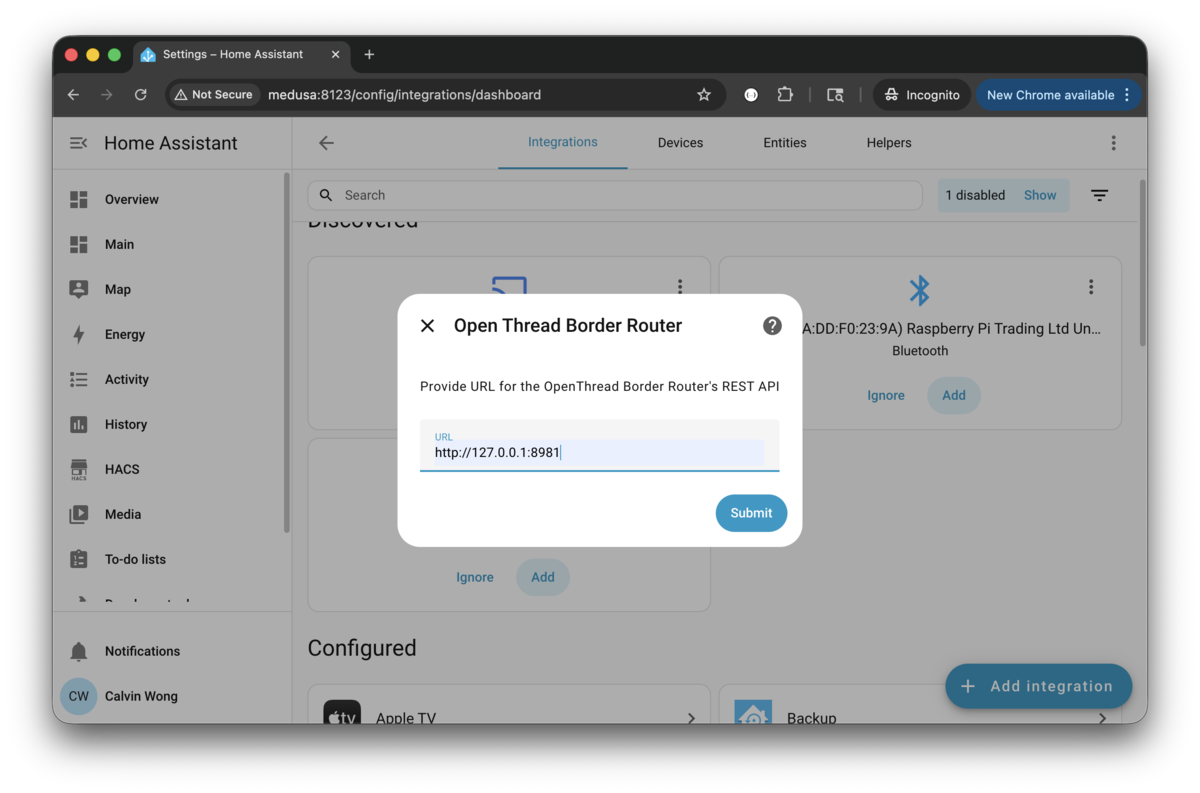
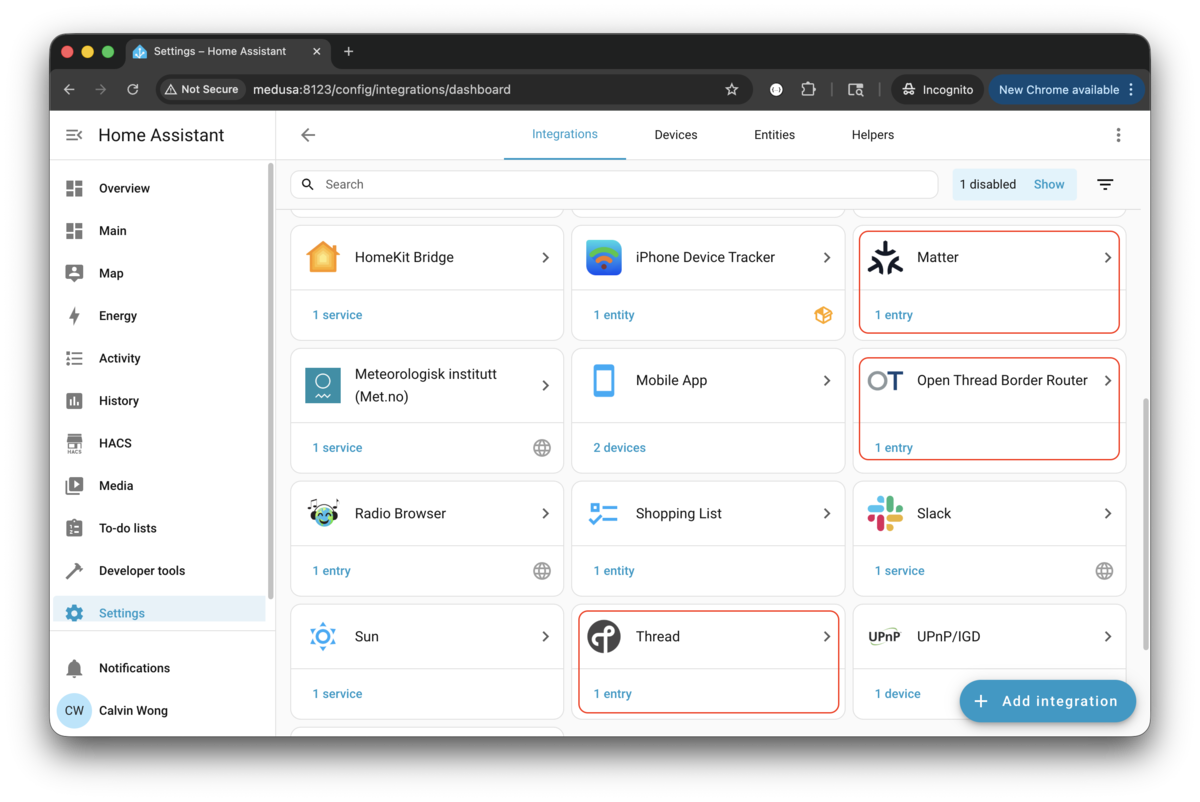
Restart all services after adding integrations:
$ docker compose restart home-assistant otbr matter-server
[+] Restarting 3/3
 ✔ Container home-assistant  Started
 ✔ Container otbr            Started
 ✔ Container matter-server   Started
Add Matter Devices via Home Assistant App
In the Home Assistant app on your phone:
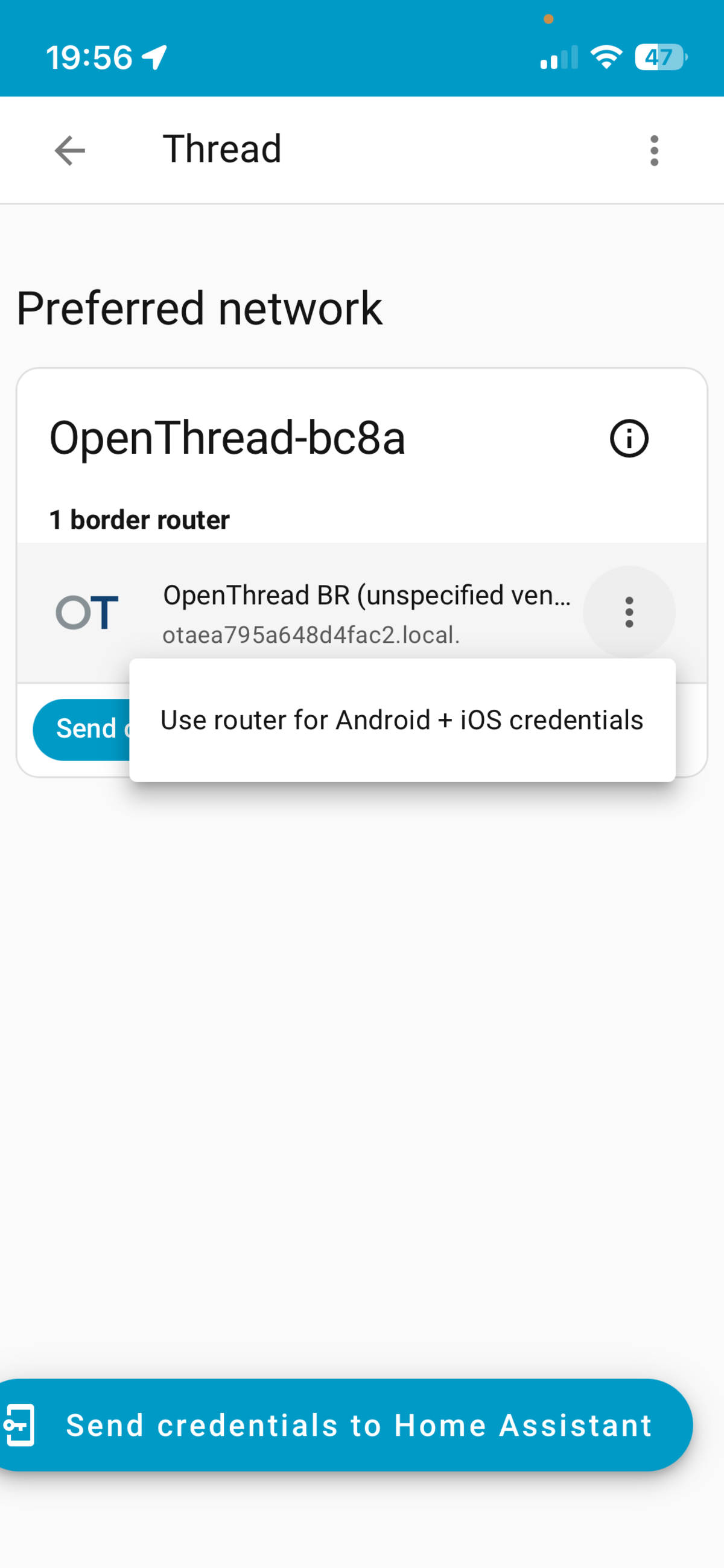
- Under the Thread integration, find
border router, tap the 3-dots, and selectUse router for Android + iOS credentials, then tapSend credentials to phone. - Go to Settings › Companion app › Debugging › Thread, find the network name, and click
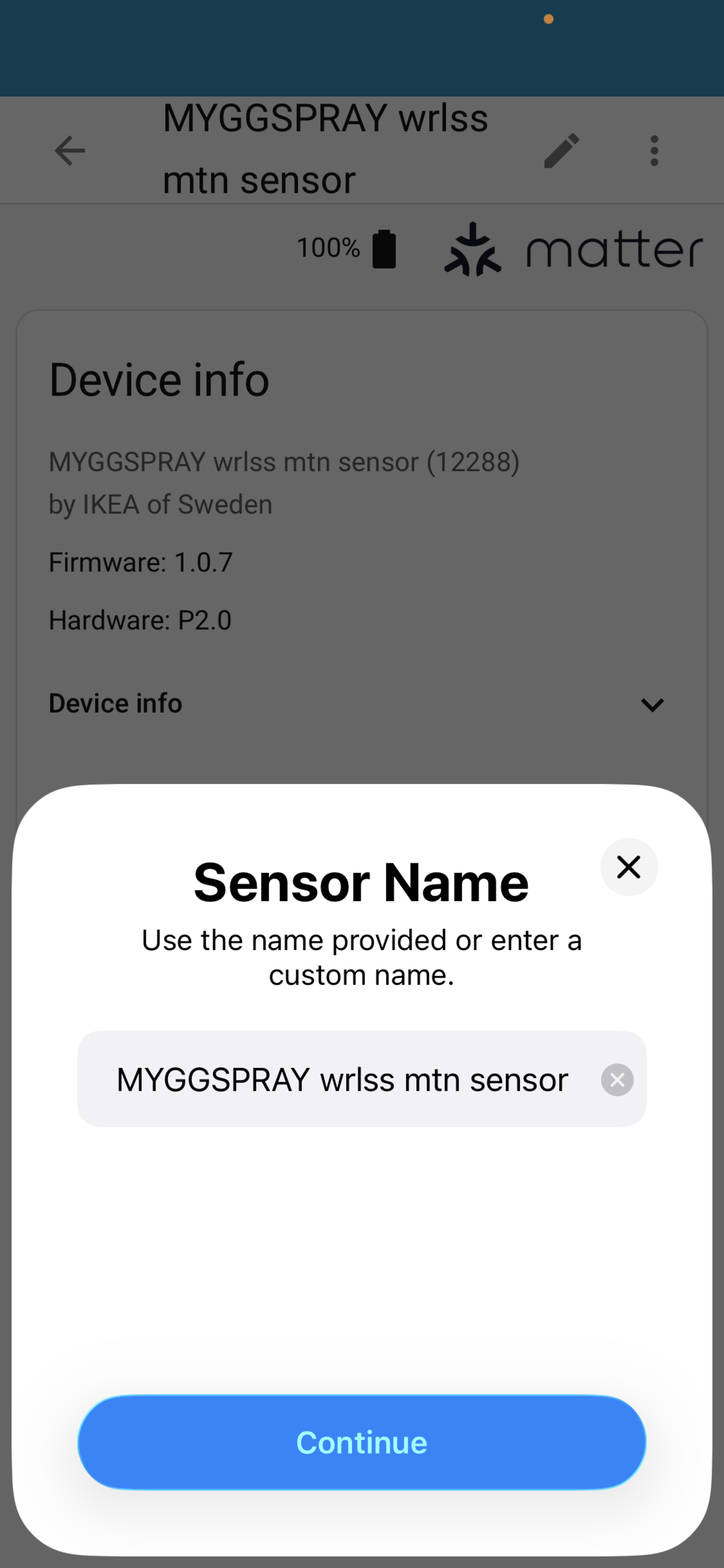
Transfer to Home Assistantto add the credential to Apple Keychain. - Add Matter devices via Settings › Devices & Services › Add Integration › Matter.
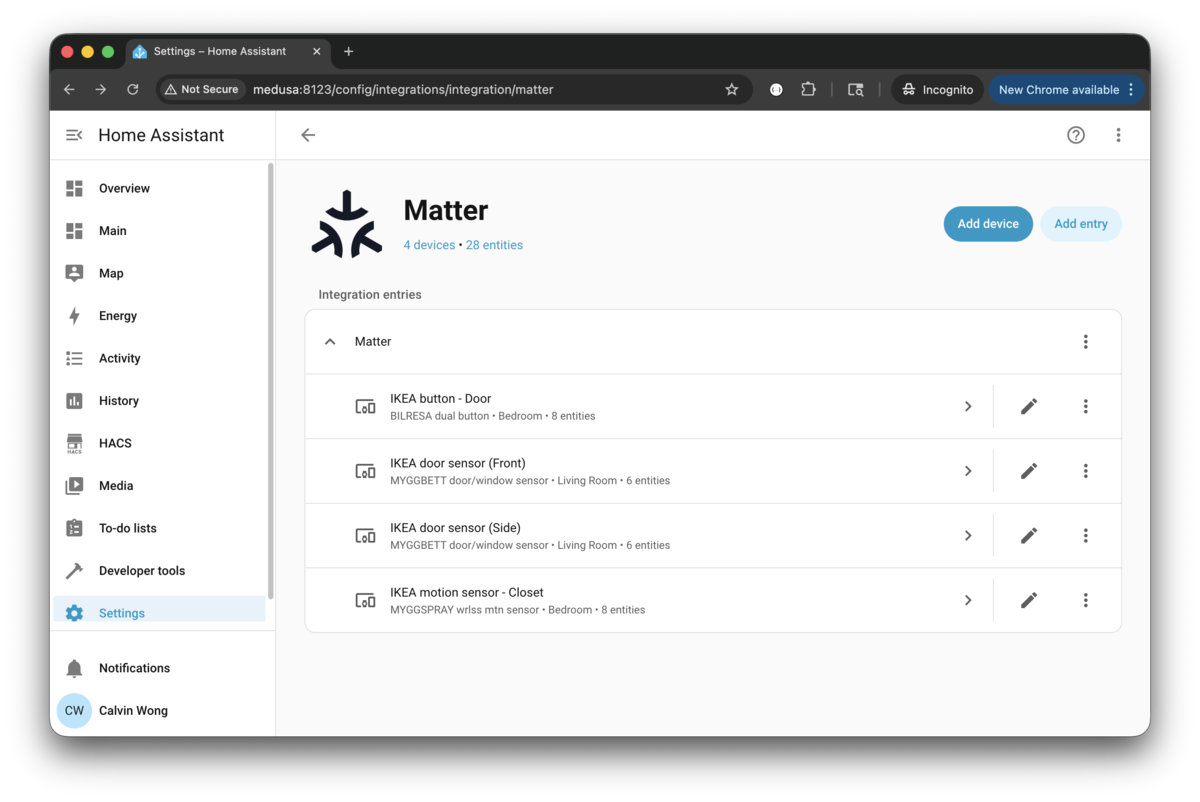
Confirm devices appear under the Matter integration:
Extra Credit
Home Assistant Cloud provides a secure remote connection, but to avoid the monthly fee I use DuckDNS and Caddy instead.
DuckDNS
Create an account at DuckDNS and pick a subdomain. Store the TOKEN in /usr/local/etc/docker/duckdns.env.
  duckdns:
    container_name: duckdns
    image: lscr.io/linuxserver/duckdns:latest
    env_file:
      - /usr/local/etc/docker/duckdns.env
    environment:
      TZ: America/Los_Angeles
      SUBDOMAINS: sub-domain-you-picked-from-duckdns
    network_mode: host
    restart: unless-stopped
Port Forwarding
Forward ports 80 and 443 on your router to the Raspberry Pi. Caddy uses these for ACME challenges and TLS traffic.
Reverse Proxy and HTTPS
  caddy:
    container_name: caddy
    image: caddy:2
    network_mode: host
    restart: unless-stopped
    volumes:
      - './caddy/etc-caddy/Caddyfile:/etc/caddy/Caddyfile'
      - './caddy/data:/data'
      - './caddy/config:/config'
Minimal Caddyfile:
##################################
# LAN HTTPS (.local)
##################################

https://home-assistant.local {
    reverse_proxy 127.0.0.1:8123 {
        transport http
    }
    encode gzip
}

##################################
# External HTTPS (DuckDNS)
##################################

home-assistant.sub-domain-you-picked-from-duckdns.duckdns.org {
    reverse_proxy 127.0.0.1:8123 {
        transport http
    }
    encode gzip
}

##################################
# Optional global HTTP -> HTTPS catch-all
##################################

http:// {
    redir https://{host}{uri}
}
Troubleshooting
When Matter devices show Unavailable, follow these steps to restore them.
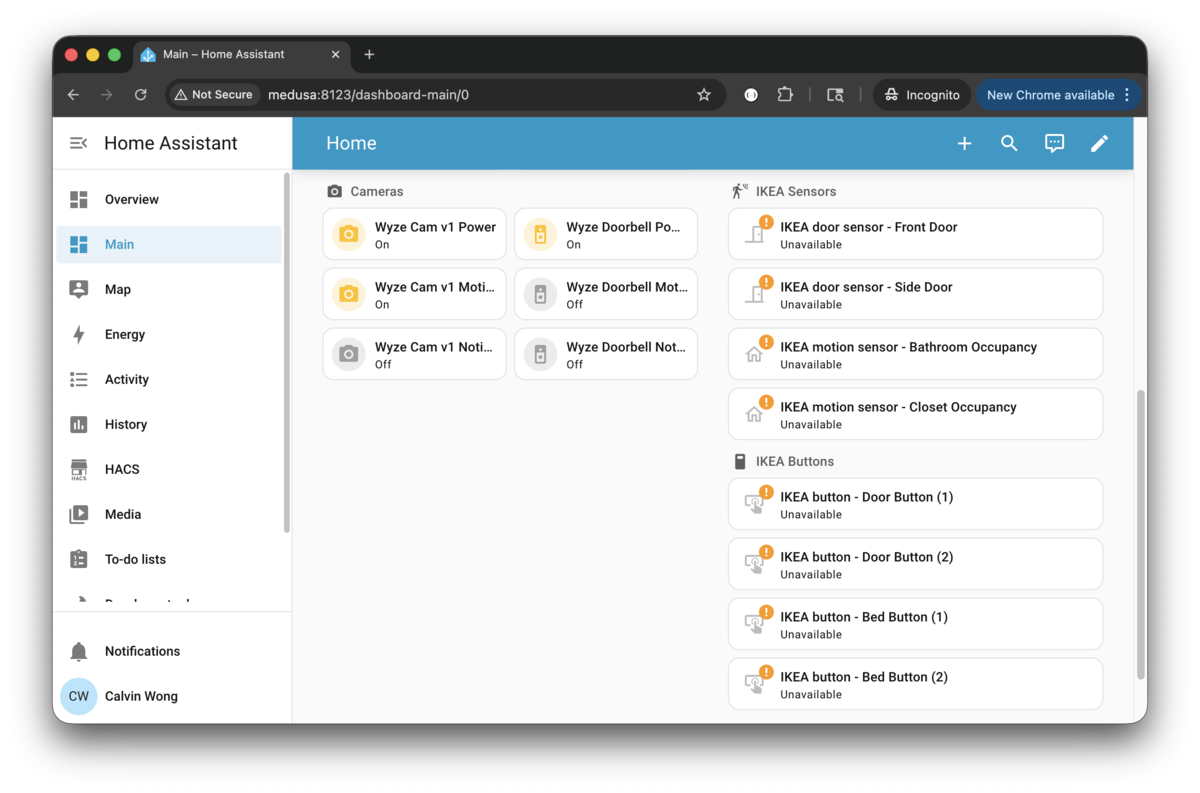
1) In Home Assistant, go to Devices & Services and delete the Thread and Open Thread Border Router integrations.
2) Stop the containers.
$ docker compose down home-assistant otbr matter-server --remove-orphans
[+] Running 3/3
 ✔ Container home-assistant  Removed
 ✔ Container matter-server   Removed
 ✔ Container otbr            Removed
3) Start the containers again.
$ docker compose up home-assistant otbr matter-server --remove-orphans -d
[+] Running 3/3
 ✔ Container otbr            Running
 ✔ Container matter-server   Running
 ✔ Container home-assistant  Running
4) Wait 15 seconds.
5) Verify OTBR status — it should show disabled with no active dataset yet.
$ docker compose exec -it otbr ot-ctl state
disabled
Done

$ docker compose exec -it otbr ot-ctl dataset active
Error 23: NotFound
6) Re-add Thread and Open Thread Border Router integrations — see Add Home Assistant Integrations.
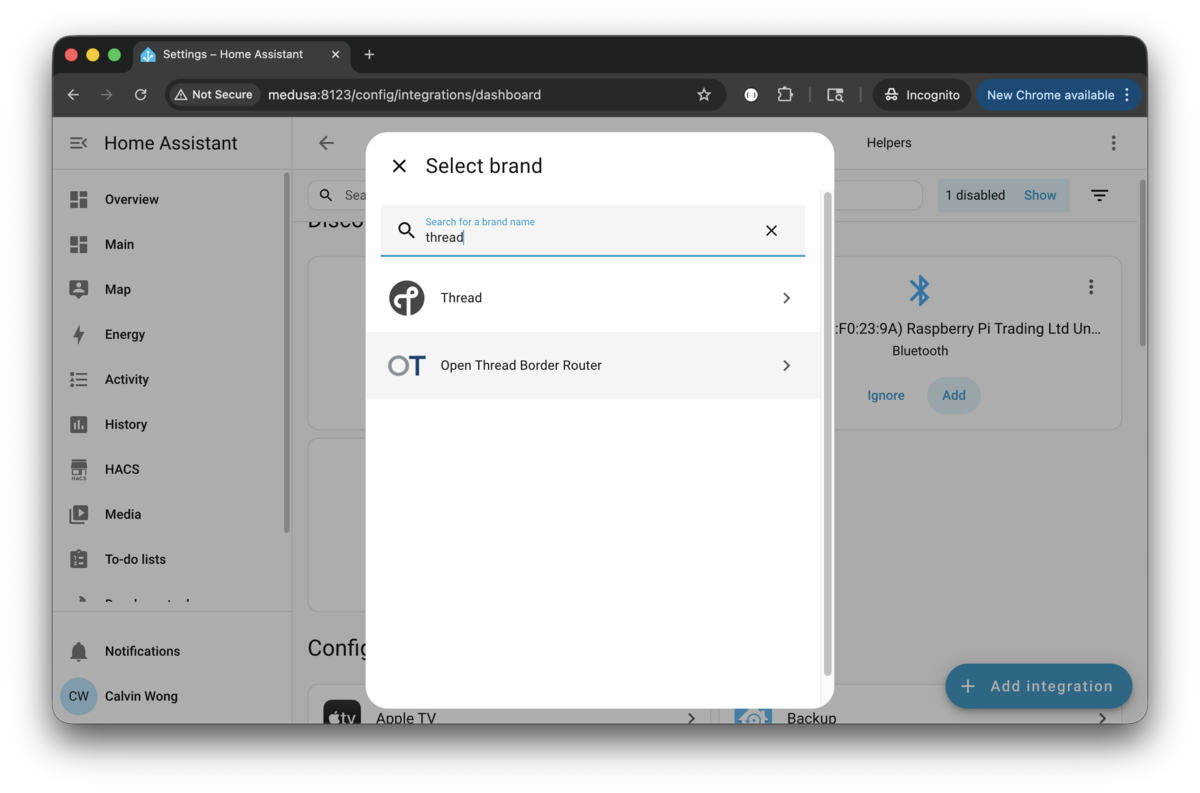
7) Confirm OTBR status — it should now show leader with an active dataset.
$ docker compose exec -it otbr ot-ctl state
leader
Done

$ docker compose exec -it otbr ot-ctl dataset active
Active Timestamp: 1
Channel: 26
Wake-up Channel: 16
Channel Mask: 0x07fff800
Ext PAN ID: 5b5ee99d71511221
Mesh Local Prefix: fdaa:a2a2:eacd:7d2d::/64
Network Key: febd7f33eee11c8805799a6daec7c892
Network Name: OpenThread-bc8a
PAN ID: 0xbc8a
PSKc: 0e9238d5939cd5597ef054de6bee7c49
Security Policy: 672 onrc 0
Done
8) Re-configure the phone app — see Add Matter Devices via Home Assistant App.
Factory Reset
Use this when the border router is in a broken state and you cannot access or pair any accessories. This resets all OpenThread network state and clears HA’s stored Thread datasets.
docker compose stop home-assistant
sudo rm -f home-assistant/config/.storage/thread.datasets

docker compose exec otbr ot-ctl factoryreset
sleep 5
docker compose exec otbr ot-ctl ifconfig up
sleep 5
docker compose exec otbr ot-ctl dataset init new
sleep 5
docker compose exec otbr ot-ctl dataset commit active
sleep 5
docker compose exec otbr ot-ctl thread start
sleep 5
docker compose exec otbr ot-ctl br enable
sleep 5
docker compose exec otbr ot-ctl state

avahi-browse -rt _meshcop._udp

docker compose start home-assistant

docker compose stop home-assistant otbr

sudo systemctl stop avahi-daemon
sudo rm -rf /var/run/avahi-daemon/*
sudo systemctl start avahi-daemon

docker compose start otbr

# wait 20sec

avahi-browse -rt _meshcop._udp

docker compose start home-assistant

# wait 2-3min — you should be able to "Send credentials to phone" and pair accessories